COVID-19 in Poland
Current COVID-19 activity in Poland — based on ECDC ERVISS weekly data, set against the parallel flu and RSV trajectories.
Current situation: COVID-19
In week 15 of 2026, activity of COVID-19 in Poland is low. The trend — derived from clinical surveillance — is stable. Over a four-week comparison, a clear decline is visible.
The classification is based on the ECDC ERVISS weekly reports, drawing on COVID-19 indicators from Poland's National Institute of Public Health NIH - National Research Institute (NIZP PZH). Seasonally, infection waves in Poland typically peak during winter, with occasional summer waves driven by new variants; activity is usually markedly lower in late spring between waves. How severe a given season becomes depends on the circulating virus variant and the population's immune status, among other factors.
Data sources and methodology
The current picture for Poland is built on the European Respiratory Virus Surveillance Summary (ERVISS), published weekly by the European Centre for Disease Prevention and Control (ECDC). the National Institute of Public Health (NIZP PZH) via the SENTINEL system is the national public-health authority that feeds ERVISS with sentinel primary care and virology data.
ECDC ERVISS
ERVISS is ECDC's weekly pan-European surveillance summary for influenza, SARS-CoV-2 and RSV. National authorities — in Poland's case the National Institute of Public Health (NIZP PZH) via the SENTINEL system — submit harmonised indicators every week, which ECDC publishes in a standardised dataset on Thursdays. Using ERVISS rather than each country's native portal ensures cross-country comparability.
ILI / ARI consultation rates and positivity
the National Institute of Public Health (NIZP PZH) via the SENTINEL system operates a sentinel network of general practices that report weekly rates of patients consulting for influenza-like illness (ILI) or acute respiratory infection (ARI). A subset of patients is swabbed and tested by reference laboratories, producing pathogen-specific positivity rates for flu, SARS-CoV-2 and RSV.
Why this source
Combining consultation incidence with virological positivity yields a pathogen-specific weekly incidence signal (ILI × positivity / 100). This is the standard European methodology and provides a more robust view than either indicator alone — consultation rates capture illness burden, positivity confirms which pathogen is driving it.
Qualitative classification
The “low”, “moderate” and “high” categories follow seasonal reference values and epidemiological thresholds calibrated to match our classifications for other countries. The ILI × positivity / 100 product is scaled to comparable thresholds using a divisor of 3, which aligns European sentinel peaks with the consultation-equivalent scale used elsewhere. Data refreshes weekly when ECDC publishes the latest ERVISS update, typically on Thursdays.
Frequently asked questions
How is COVID-19 tracked in Poland?
COVID-19 surveillance in Poland sits inside the broader respiratory-virus framework run by NIZP PZH. SARS-CoV-2 is reported alongside influenza and RSV via sentinel and non-sentinel networks, with results feeding into ECDC's ERVISS platform. Since mass testing wound down, the useful signals are laboratory positivity among tested respiratory samples, hospital admissions for severe acute respiratory infection, and — where available — variant sampling.
Does Poland still see distinct COVID-19 waves?
Yes, but the pattern is less tightly seasonal than influenza. Poland has seen recurring autumn and winter waves, often triggered by new Omicron sublineages that partially escape earlier immunity. Summer upticks occur as well. Because NIZP PZH reports COVID-19 within the combined respiratory panel, waves are now read as shifts in positivity and hospitalisation rather than through absolute case counts.
How does Poland's COVID-19 signal appear in ECDC data?
Poland contributes SARS-CoV-2 positivity and severity indicators to ECDC's ERVISS and country profiles. This allows a direct comparison of Polish trends with those of Germany, Czechia, Slovakia, and other neighbours. Because all countries use the same reporting template, relative intensity — low, moderate, high, very high — is meaningful across borders, even if absolute numbers are not fully comparable.
Is COVID-19 still considered dangerous in Poland?
For most people with vaccine- or infection-induced immunity, current variants behave like a moderate respiratory illness. Risk remains concentrated in older adults, immunocompromised patients, and people with chronic heart or lung disease. Polish public-health guidance continues to recommend seasonal booster doses for risk groups, aligned with ECDC and WHO Europe recommendations. Ongoing surveillance is what allows that risk to be managed without blanket restrictions.
How do I interpret qualitative COVID-19 activity levels?
NIZP PZH and ECDC use tiered activity classifications — baseline through very high — derived from historical positivity and severity ranges. These tiers describe how the current week compares with previous seasons, not how many people are infected in absolute terms. A shift from moderate to high signals meaningful additional pressure on primary care and hospitals, even when case-level data is incomplete.
Want the actual numbers?
You'll find them in the app.
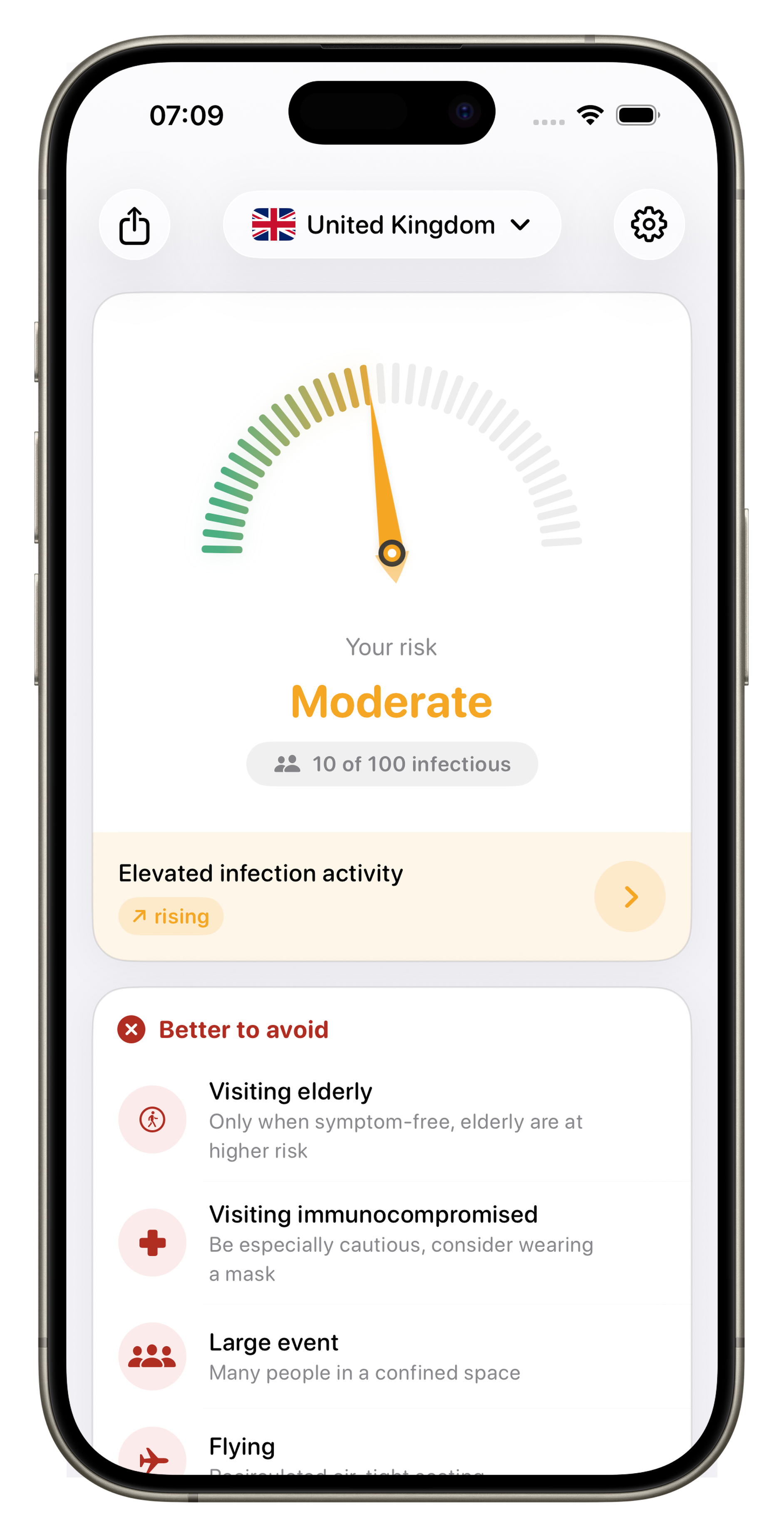
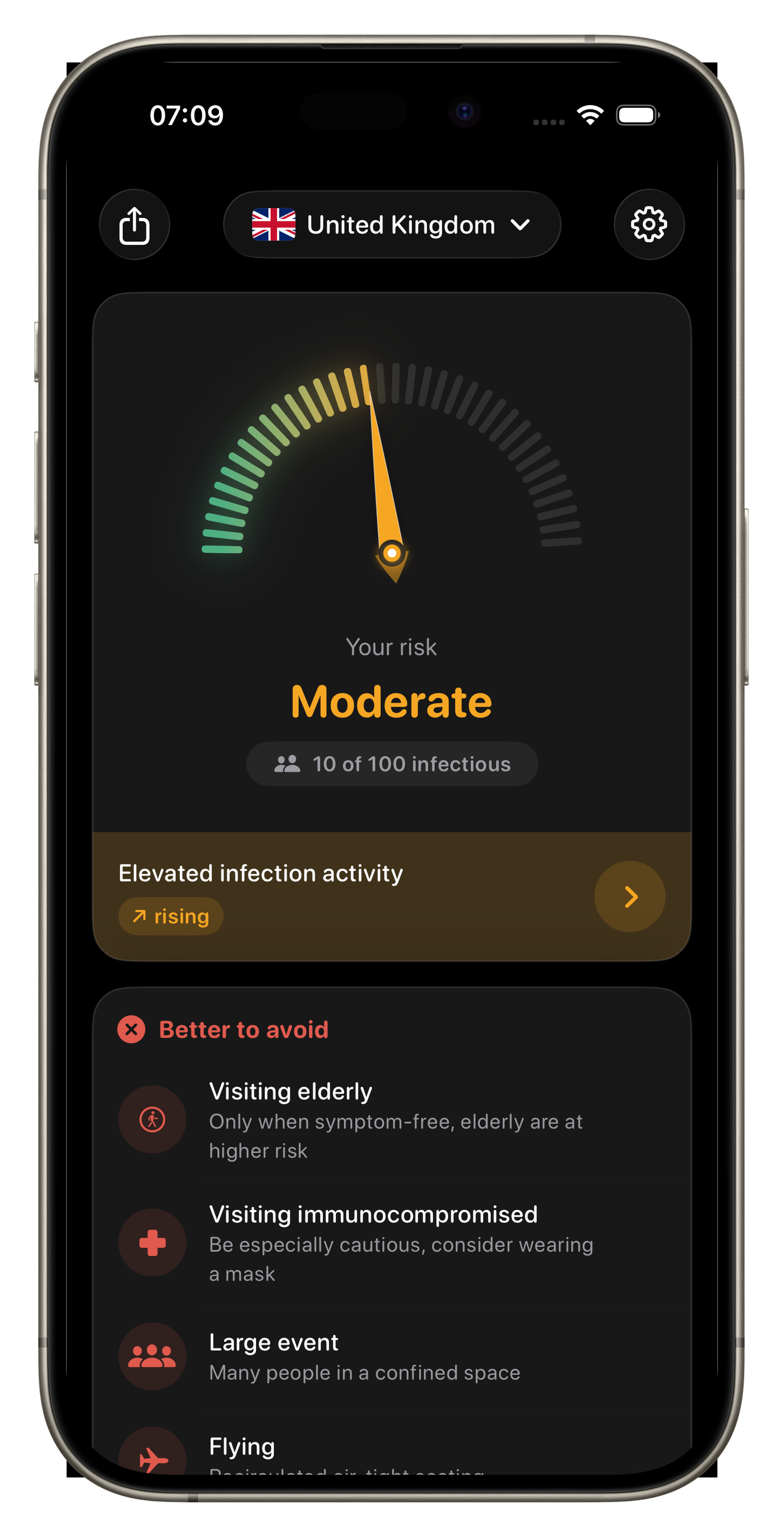
Here you only see the trend. In the app: exact incidence rates, “X out of 100 people infectious”, your personal risk based on age and pre-existing conditions, wastewater trends, 36 countries, home-screen widget.