Flu season in Finland
Current flu, COVID-19 and RSV activity in Finland — based on ECDC ERVISS weekly data from the Finnish Institute for Health and Welfare (THL). Rescaled into a consultation-equivalent signal for a qualitative low / moderate / high classification.
Current situation: Influenza
In week 15 of 2026, activity of influenza (seasonal flu) in Finland is low. The trend — derived from clinical surveillance — is stable. Activity has barely shifted over the past few weeks.
The classification is based on the ECDC ERVISS weekly reports, drawing on data from the Finnish Institute for Health and Welfare (THL) via its sentinel GP network and the National Reference Laboratory. Seasonally, infection waves in Finland typically peak between January and March; activity is usually markedly lower during the summer months. How severe a given season becomes depends on the circulating virus variant and the population's immune status, among other factors.
Data sources and methodology
The current picture for Finland is built on the European Respiratory Virus Surveillance Summary (ERVISS), published weekly by the European Centre for Disease Prevention and Control (ECDC). the Finnish Institute for Health and Welfare (THL) via its sentinel GP network and the National Reference Laboratory is the national public-health authority that feeds ERVISS with sentinel primary care and virology data.
ECDC ERVISS
ERVISS is ECDC's weekly pan-European surveillance summary for influenza, SARS-CoV-2 and RSV. National authorities — in Finland's case the Finnish Institute for Health and Welfare (THL) via its sentinel GP network and the National Reference Laboratory — submit harmonised indicators every week, which ECDC publishes in a standardised dataset on Thursdays. Using ERVISS rather than each country's native portal ensures cross-country comparability.
ILI / ARI consultation rates and positivity
the Finnish Institute for Health and Welfare (THL) via its sentinel GP network and the National Reference Laboratory operates a sentinel network of general practices that report weekly rates of patients consulting for influenza-like illness (ILI) or acute respiratory infection (ARI). A subset of patients is swabbed and tested by reference laboratories, producing pathogen-specific positivity rates for flu, SARS-CoV-2 and RSV.
Why this source
Combining consultation incidence with virological positivity yields a pathogen-specific weekly incidence signal (ILI × positivity / 100). This is the standard European methodology and provides a more robust view than either indicator alone — consultation rates capture illness burden, positivity confirms which pathogen is driving it.
Qualitative classification
The “low”, “moderate” and “high” categories follow seasonal reference values and epidemiological thresholds calibrated to match our classifications for other countries. The ILI × positivity / 100 product is scaled to comparable thresholds using a divisor of 3, which aligns European sentinel peaks with the consultation-equivalent scale used elsewhere. Data refreshes weekly when ECDC publishes the latest ERVISS update, typically on Thursdays.
Frequently asked questions
When is flu season in Finland?
Finnish flu activity usually begins rising in late December, peaks between January and March, and fades into April. As in the other Nordic countries, the cold, dark months concentrate indoor contacts and drive winter respiratory transmission. THL — the Finnish Institute for Health and Welfare (Terveyden ja hyvinvoinnin laitos) — publishes weekly influenza updates through its sentinel GP network and National Reference Laboratory. The exact onset and peak shift year to year with the dominant subtypes.
How does THL classify flu severity?
THL describes influenza activity in qualitative phases — baseline, increasing, epidemic, and declining — based on sentinel consultations, laboratory positivity, and severe acute respiratory infection signals from hospitals. These classifications appear in the weekly respiratory-virus bulletin and are also transmitted to ECDC for the European Respiratory Virus Surveillance Summary (ERVISS). The qualitative framing puts each winter in context against previous seasons.
How is flu surveillance organised in Finland?
Finland's influenza surveillance combines a sentinel network of primary-care physicians, virological confirmation at the National Reference Laboratory at THL, and hospital notifications of severe cases. Weekly data are integrated into a single respiratory-virus bulletin that covers flu, SARS-CoV-2, and RSV. The same indicators feed ECDC ERVISS, which places Finland's trajectory alongside Sweden, Norway, and the rest of the EU/EEA.
Is the flu vaccine free in Finland?
Finland offers free seasonal influenza vaccination to a broad set of groups defined in the national immunisation programme, including children aged six months to six years, older adults, pregnant women, people with chronic illnesses, and healthcare workers. Vaccines are delivered through municipal health centres and occupational-health services. THL publishes vaccine-coverage estimates alongside the weekly surveillance bulletin.
How does Finland compare to its Nordic neighbours?
Because Finland reports into ECDC ERVISS with harmonised indicators, its weekly flu classification is directly comparable with Sweden, Norway, Denmark, and Iceland. Nordic countries tend to see broadly similar peak windows between January and March, with lead–lag patterns of a few weeks reflecting school holidays and travel. ECDC's side-by-side dashboards make these cross-country comparisons easy to read.
Want the actual numbers?
You'll find them in the app.
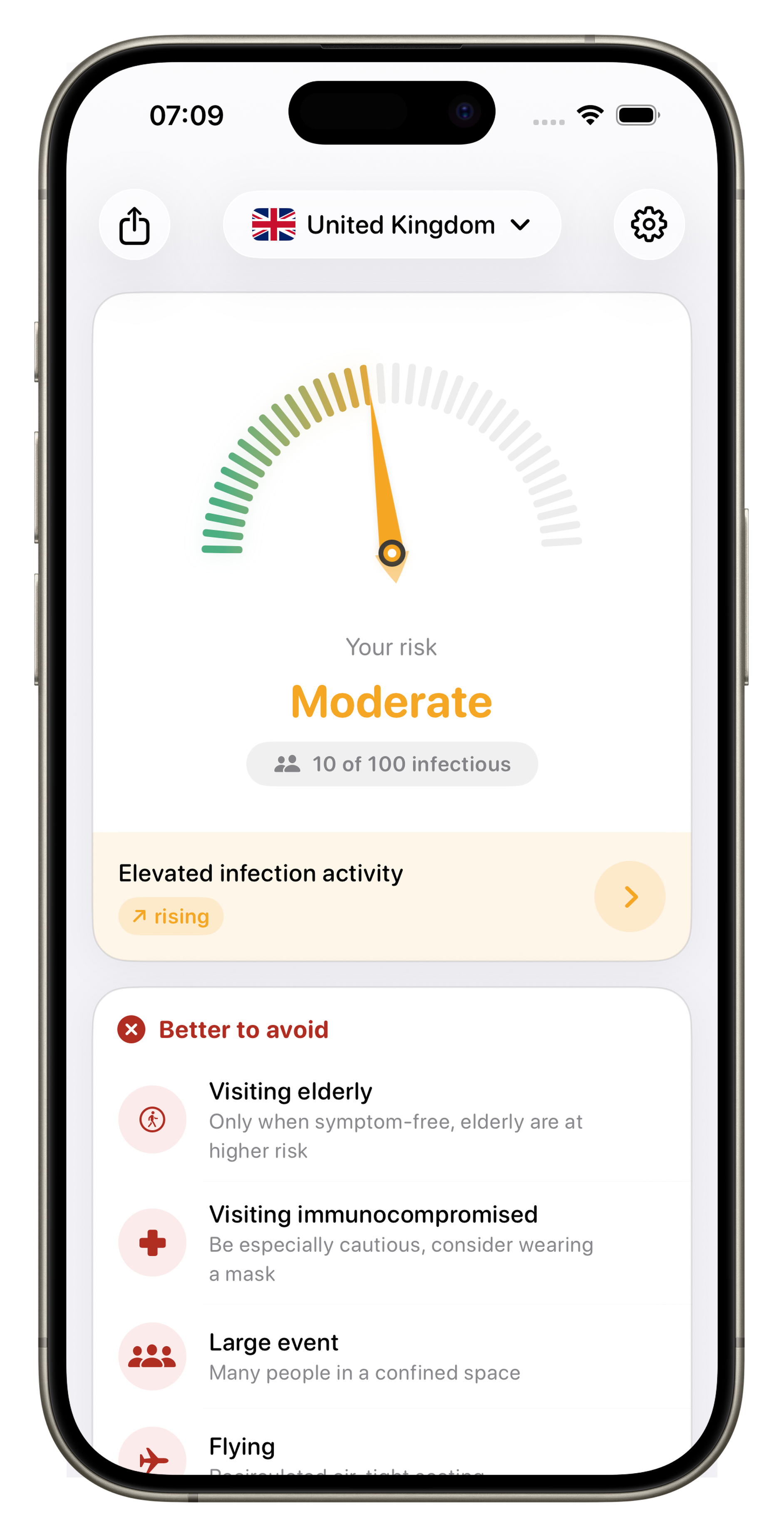
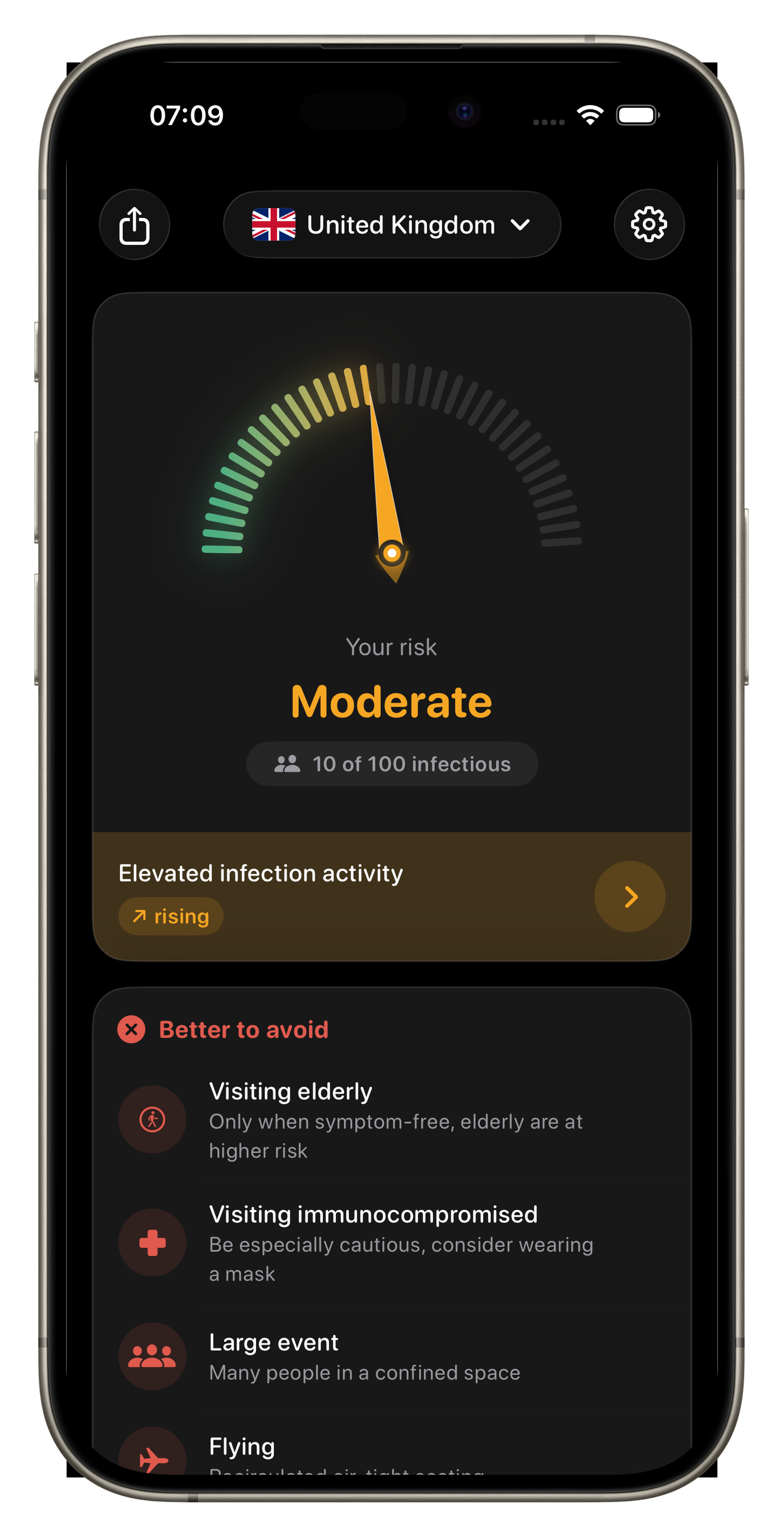
Here you only see the trend. In the app: exact incidence rates, “X out of 100 people infectious”, your personal risk based on age and pre-existing conditions, wastewater trends, 36 countries, home-screen widget.