Flu season in Portugal
Current flu, COVID-19 and RSV activity in Portugal — based on ECDC ERVISS weekly data from the Instituto Nacional de Saúde Doutor Ricardo Jorge (INSA). Rescaled into a consultation-equivalent signal for a qualitative low / moderate / high classification.
Current situation: Influenza
In week 15 of 2026, activity of influenza (seasonal flu) in Portugal is low. The trend — derived from clinical surveillance — is stable.
The classification is based on the ECDC ERVISS weekly reports, drawing on data from the Instituto Nacional de Saúde Doutor Ricardo Jorge (INSA) via the Médicos-Sentinela network. Seasonally, infection waves in Portugal typically peak between December and February; activity is usually markedly lower during the summer months. How severe a given season becomes depends on the circulating virus variant and the population's immune status, among other factors.
Data sources and methodology
The current picture for Portugal is built on the European Respiratory Virus Surveillance Summary (ERVISS), published weekly by the European Centre for Disease Prevention and Control (ECDC). the Instituto Nacional de Saúde Doutor Ricardo Jorge (INSA) via the Médicos-Sentinela network is the national public-health authority that feeds ERVISS with sentinel primary care and virology data.
ECDC ERVISS
ERVISS is ECDC's weekly pan-European surveillance summary for influenza, SARS-CoV-2 and RSV. National authorities — in Portugal's case the Instituto Nacional de Saúde Doutor Ricardo Jorge (INSA) via the Médicos-Sentinela network — submit harmonised indicators every week, which ECDC publishes in a standardised dataset on Thursdays. Using ERVISS rather than each country's native portal ensures cross-country comparability.
ILI / ARI consultation rates and positivity
the Instituto Nacional de Saúde Doutor Ricardo Jorge (INSA) via the Médicos-Sentinela network operates a sentinel network of general practices that report weekly rates of patients consulting for influenza-like illness (ILI) or acute respiratory infection (ARI). A subset of patients is swabbed and tested by reference laboratories, producing pathogen-specific positivity rates for flu, SARS-CoV-2 and RSV.
Why this source
Combining consultation incidence with virological positivity yields a pathogen-specific weekly incidence signal (ILI × positivity / 100). This is the standard European methodology and provides a more robust view than either indicator alone — consultation rates capture illness burden, positivity confirms which pathogen is driving it.
Qualitative classification
The “low”, “moderate” and “high” categories follow seasonal reference values and epidemiological thresholds calibrated to match our classifications for other countries. The ILI × positivity / 100 product is scaled to comparable thresholds using a divisor of 3, which aligns European sentinel peaks with the consultation-equivalent scale used elsewhere. Data refreshes weekly when ECDC publishes the latest ERVISS update, typically on Thursdays.
Frequently asked questions
When is flu season in Portugal?
Portuguese flu activity typically starts rising in December, peaks between December and February, and eases by March. The exact window varies year to year with the dominant influenza subtypes and residual population immunity. INSA — the Instituto Nacional de Saúde Doutor Ricardo Jorge — publishes weekly updates describing the season in qualitative phases rather than precise onset dates.
How does INSA classify flu severity?
The Instituto Nacional de Saúde Doutor Ricardo Jorge classifies flu activity in qualitative intensity levels — baseline, low, medium, high, very high — drawing on the Médicos Sentinela GP network, sentinel-laboratory positivity, and hospital indicators. Each week's classification is compared with historical reference ranges. INSA also transmits Portuguese indicators to ECDC for inclusion in ERVISS.
How is flu surveillance organised in Portugal?
Portugal's flu surveillance combines the Médicos Sentinela network — a long-established sentinel system of general practitioners reporting influenza-like illness — with sentinel-laboratory virology coordinated by INSA, including the National Reference Laboratory for Influenza and Other Respiratory Viruses. Hospital-admission data for severe acute respiratory infection complements the primary-care signal. Weekly bulletins summarise the picture and feed ECDC ERVISS.
Is the flu vaccine free in Portugal?
Portugal offers free seasonal flu vaccination each autumn to priority groups including adults aged 60 and above, pregnant women, people with chronic conditions, residents of long-term-care facilities, and healthcare workers, administered through primary-care units and pharmacies under the Direção-Geral da Saúde programme. INSA publishes vaccination-coverage estimates alongside its weekly flu surveillance.
How does Portugal compare to its European neighbours?
Because Portugal reports into ECDC ERVISS with harmonised indicators, its weekly flu classification is directly comparable with Spain, France, Italy, and the rest of the EU/EEA. Iberian flu curves often move broadly in step, with small lead–lag differences driven by school calendars and travel patterns. Portugal's mild Atlantic climate means peaks can sit slightly later or be less sharp than in colder continental countries.
Want the actual numbers?
You'll find them in the app.
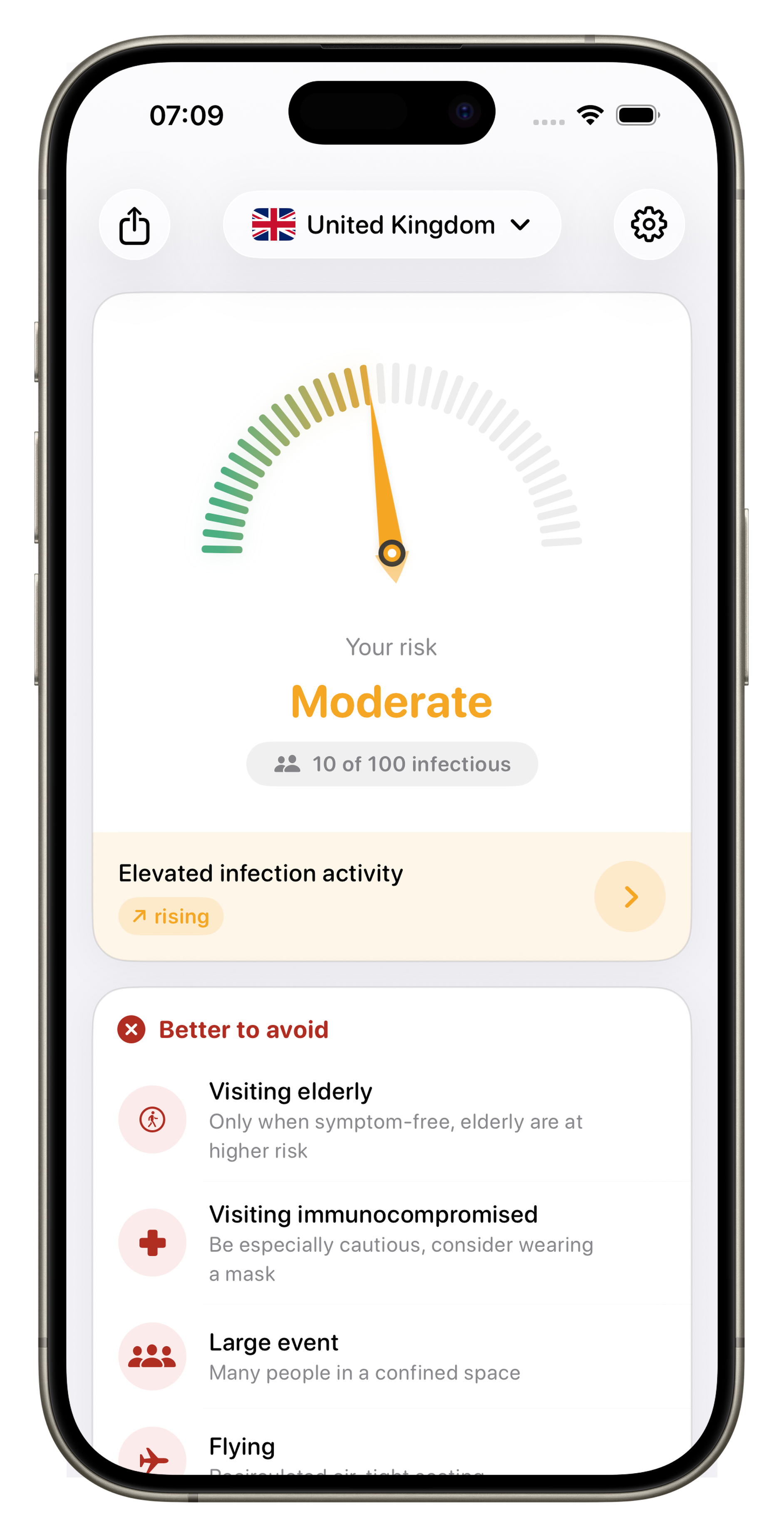
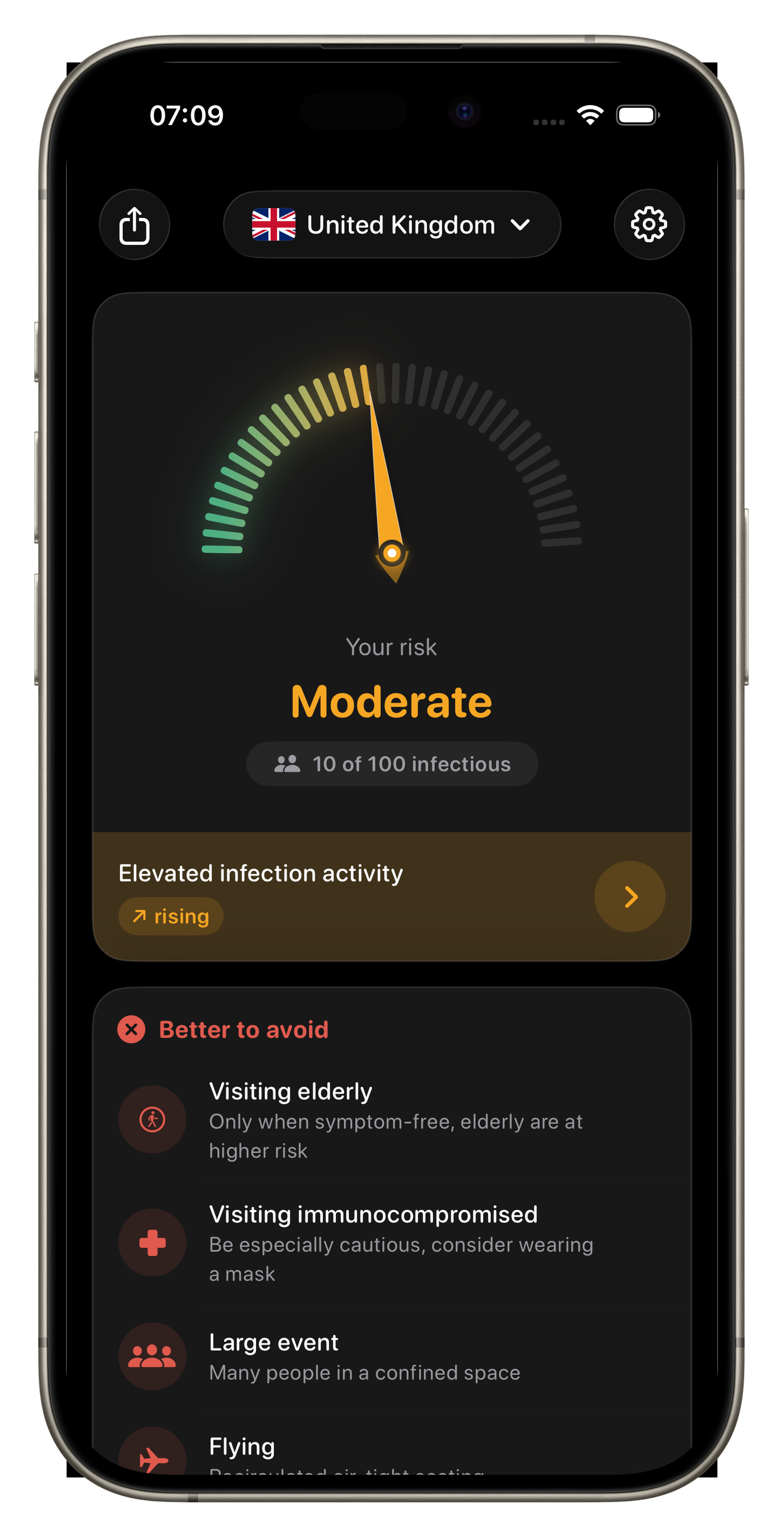
Here you only see the trend. In the app: exact incidence rates, “X out of 100 people infectious”, your personal risk based on age and pre-existing conditions, wastewater trends, 36 countries, home-screen widget.