RSV activity in India
Current respiratory syncytial virus (RSV) activity in India — based on WHO FluNet sentinel surveillance, set against the parallel flu and COVID-19 trajectories.
Current situation: RSV
In week 15 of 2026, activity of respiratory syncytial virus (RSV) in India is low. The trend — derived from clinical surveillance — is falling. A slight downward trend has emerged over recent weeks.
The classification is based on the WHO FluNet aggregate of Indian sentinel laboratory sites (SENTINEL filter applied), which carries RSV positivity indicators. Seasonally, infection waves in India typically peak between December and February; activity is usually markedly lower in spring and summer. How severe a given season becomes depends on the circulating virus variant and the population's immune status, among other factors.
Data sources and methodology
The current picture for India is built on WHO FluNet, the World Health Organization's global platform for influenza surveillance. multiple national sentinel laboratories reports weekly sentinel laboratory results to FluNet, which we translate into a consultation-equivalent signal. We apply a SENTINEL-only filter because NON-SENTINEL reporting streams in India carry too much noise to be informative.
WHO FluNet
FluNet is the WHO's weekly global influenza surveillance database. National influenza centres and reference laboratories — for India this is multiple national sentinel laboratories — submit the number of respiratory specimens tested and the number positive for influenza and, where available, RSV. Using FluNet ensures a consistent, internationally comparable data source for countries without a European-style sentinel consultation system.
Positivity-based signal
Unlike ECDC ERVISS, FluNet does not carry outpatient consultation rates. Our headline signal is therefore derived from the weekly lab positivity rate (percent of tested specimens that are positive), multiplied by a pathogen-specific scaling factor — 80 for influenza and 50 for RSV — to approximate a consultation-equivalent incidence. COVID-19 is not available via FluNet and is therefore not shown for these countries.
Why this source
FluNet is the only weekly, comparable dataset covering many non-European countries. Positivity is relatively insensitive to changes in overall testing volume, which makes it a reasonable proxy for underlying transmission pressure even when the denominator fluctuates. We apply a SENTINEL-only filter where appropriate to reduce noise from non-sentinel reporting streams.
Qualitative classification
The “low”, “moderate” and “high” categories follow seasonal reference values and epidemiological thresholds calibrated to match our classifications for other countries. The positivity × scaling-factor product is mapped to the same consultation-equivalent scale we use elsewhere so results stay comparable across regions. Data refreshes weekly when WHO publishes the latest FluNet update.
Frequently asked questions
When is RSV season in India?
RSV activity in India tends to follow a monsoon pattern in many regions, with peaks during the rainy months and a secondary winter rise in northern states. Paediatric admissions for RSV bronchiolitis typically cluster during these windows. The pattern is broadly consistent with other South and South-East Asian countries and differs from the winter-only peak seen in Europe.
How is RSV monitored in India?
RSV surveillance in India runs through the same sentinel laboratory network that supports influenza reporting under ICMR/NCDC, with paediatric reference sites contributing virological testing data. Weekly aggregated positivity indicators for RSV are submitted to WHO FluNet via the South-East Asia regional reporting framework.
Who is most at risk from RSV in India?
The highest-risk groups are infants under six months, preterm babies, and children with congenital cardiopulmonary disease. Older adults with chronic lung or heart conditions are also at elevated risk. In India, RSV bronchiolitis is a significant driver of paediatric hospital admissions during seasonal peaks.
Why does India's RSV pattern differ from Europe's?
India's monsoon climate and regional heterogeneity produce RSV peaks tied to rainy-season conditions rather than the cold-dry winter pattern seen in Europe. Indoor crowding during monsoons favours droplet transmission, and humidity affects viral stability differently from the European winter environment. WHO FluNet's harmonised reporting makes these contrasting patterns directly comparable.
How does RSV differ from flu in Indian data?
Indian sentinel data treats flu and RSV as separate positivity streams. RSV is dominated by paediatric presentations, while flu activity spreads more evenly across age bands. Peak timing can differ between the two, particularly in monsoon-dominated regions where RSV may lead flu. Clinical overlap is wide, so laboratory confirmation is the basis for distinguishing them in the surveillance data.
Want the actual numbers?
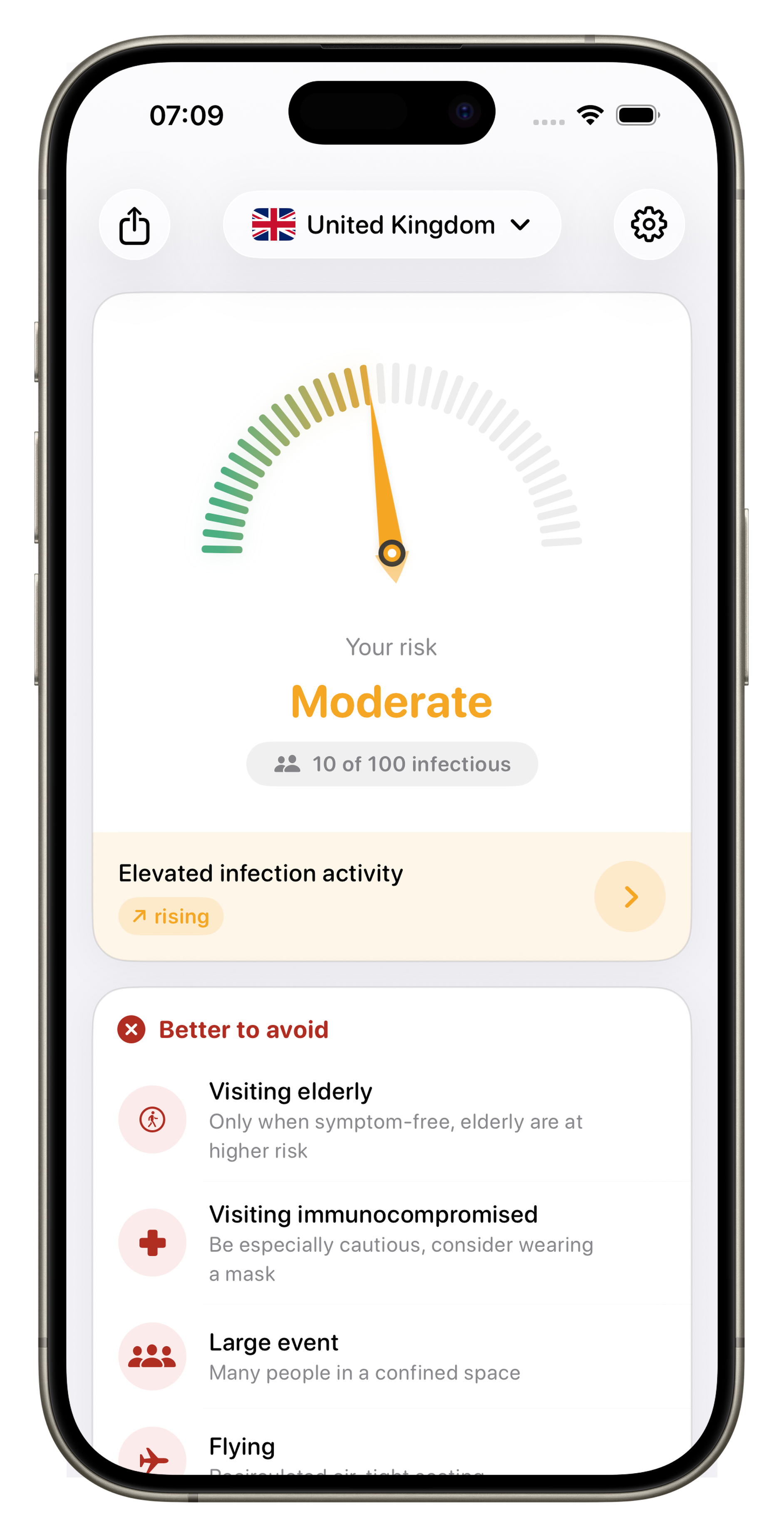
You'll find them in the app.
Here you only see the trend. In the app: exact incidence rates, “X out of 100 people infectious”, your personal risk based on age and pre-existing conditions, wastewater trends, 36 countries, home-screen widget.