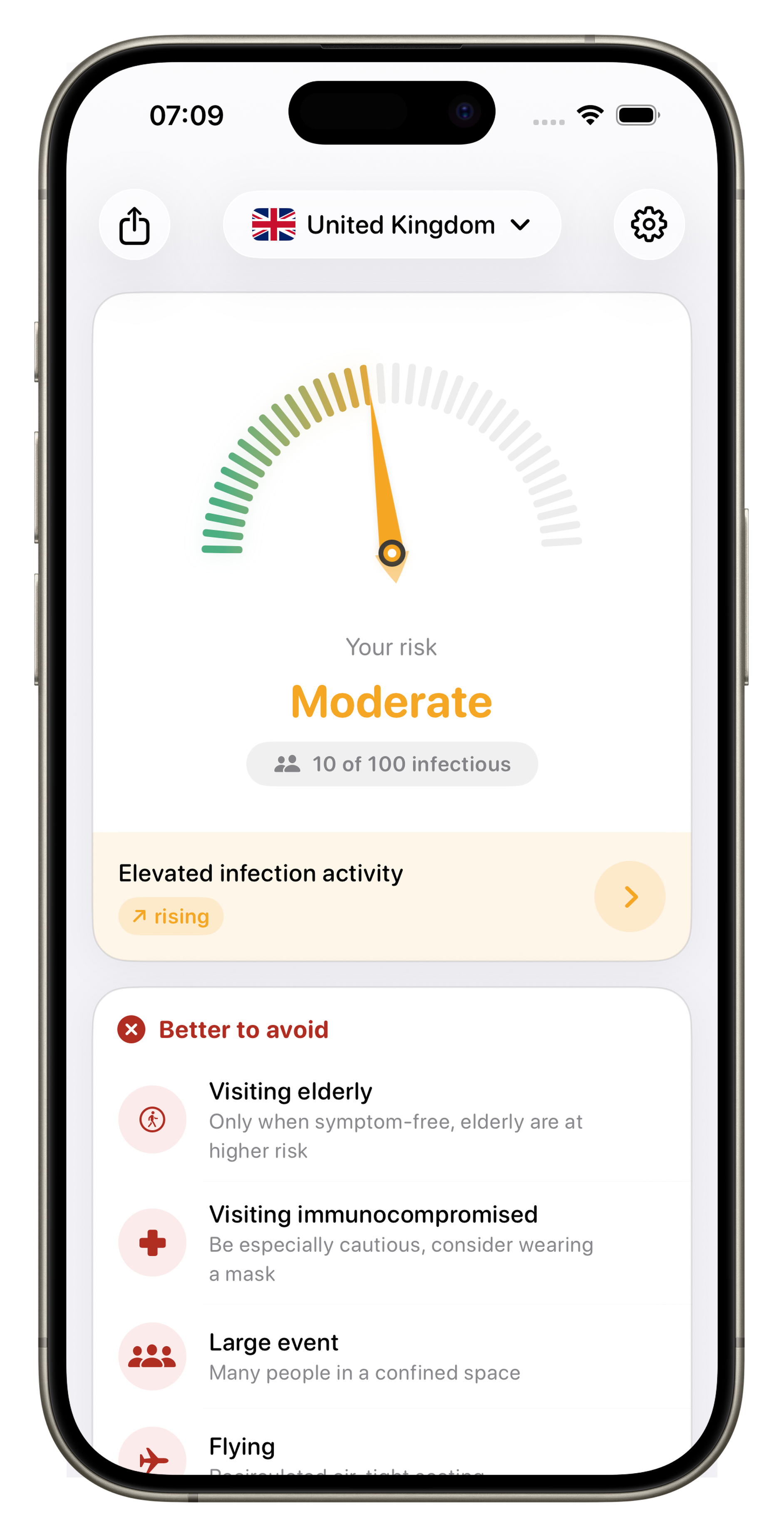
COVID-19 in the United Kingdom
Current COVID-19 activity in the UK — based on UKHSA Dashboard weekly case rate rolling mean, set against the parallel flu and RSV trajectories.
Current situation: COVID-19
In week 15 of 2026, activity of COVID-19 in the United Kingdom is low. The trend — derived from weekly hospital admission rates — is falling. Over a four-week comparison, a clear decline is visible.
The classification is based on the UKHSA Respiratory Surveillance Dashboard, which aggregates COVID-19 hospital admission rates alongside RCGP sentinel indicators. Seasonally, infection waves in the United Kingdom typically peak during winter, with occasional summer waves driven by new variants; activity is usually markedly lower in late spring between waves. How severe a given season becomes depends on the circulating virus variant and the population's immune status, among other factors.
Data sources and methodology
The current picture for the United Kingdom is built on the UK Health Security Agency (UKHSA) Dashboard. UKHSA is the national public-health authority for England and publishes weekly NHS England hospital admission rates for influenza and RSV, alongside daily case rate data for COVID-19. We rescale these signals into a consultation-equivalent indicator so the qualitative “low / moderate / high” categories are consistent with how we report other countries.
UKHSA Dashboard
The UKHSA Dashboard is the official public data portal of the UK Health Security Agency. It aggregates surveillance data from NHS England, sentinel primary care networks and laboratory reporting. For our headline level we use the weekly hospital admission rates for flu and RSV, and the daily COVID-19 case rate series.
Hospital admission rates
Flu and RSV are reported as laboratory-confirmed hospital admissions per 100,000 population per week, submitted by NHS England trusts. For COVID-19 the UKHSA Dashboard exposes a daily case rate series, which we aggregate into a weekly rolling mean. Together these give a stable signal of severe respiratory illness pressure that is robust to changes in individual testing behaviour.
Why this source
UKHSA is the authoritative source for England-wide respiratory surveillance and the only one to publish hospital admission rates with national coverage on a weekly cadence. Hospital admissions reflect the load on the healthcare system and update with roughly a one-week lag, while the COVID case-rate series tracks transmission more directly.
Qualitative classification
The “low”, “moderate” and “high” categories follow seasonal reference values and epidemiological thresholds calibrated to match our classifications for other countries. Admission rates and the COVID case-rate series are scaled to consultation-equivalent incidence using pathogen-specific conversion factors derived from typical seasonal peaks. Data refreshes weekly when UKHSA publishes the latest Dashboard update.
Frequently asked questions
How is COVID-19 monitored in the UK now?
With mass community testing wound down, UKHSA tracks COVID-19 mainly through hospital admissions, the SARI-Watch severe-illness network, laboratory-confirmed cases from NHS settings, and variant sequencing by the COG-UK successor programme. The UKHSA Dashboard publishes these indicators weekly. Wastewater monitoring, run in partnership with the Environment Agency in earlier years, has been scaled back but selected signals continue to inform the overall picture.
Is COVID-19 still a serious concern in the UK?
COVID-19 is now endemic in the UK and continues to cause hospitalisations and deaths each winter, concentrated in older adults and people with weakened immune systems. For most vaccinated adults with prior infections, current variants tend to cause an illness broadly similar to flu. Long COVID remains a concern and is monitored through ONS surveys and NHS specialist clinics. Risk is managed via targeted boosters rather than population-wide restrictions.
When do COVID-19 waves happen in the UK?
COVID-19 in the UK has not locked into a single seasonal rhythm. A winter wave has recurred each year since 2020, usually overlapping with flu and RSV, but additional waves have appeared in spring and late summer whenever a new variant with an immune-escape advantage has emerged. UKHSA's variant surveillance is therefore watched alongside hospitalisations for early signs of a resurgence.
Who is eligible for a COVID-19 booster on the NHS?
The NHS offers seasonal COVID-19 boosters to groups advised by the JCVI, typically including adults aged 65 and over, residents in care homes for older adults, people aged 6 months to 64 in clinical risk groups, pregnant women, and frontline health and social care workers. Eligibility is reviewed each autumn and spring. Booster uptake is reported by UKHSA alongside flu vaccination figures.
Are new variants still a risk?
Yes, SARS-CoV-2 continues to evolve, and new sublineages are detected by routine UK sequencing. Most emerging variants cause illness broadly comparable to their predecessors, but occasional lineages with clear immune escape can drive faster, larger waves. UKHSA publishes variant technical briefings describing growth advantage and, where relevant, any signals around severity or vaccine effectiveness.
Want the actual numbers?
You'll find them in the app.
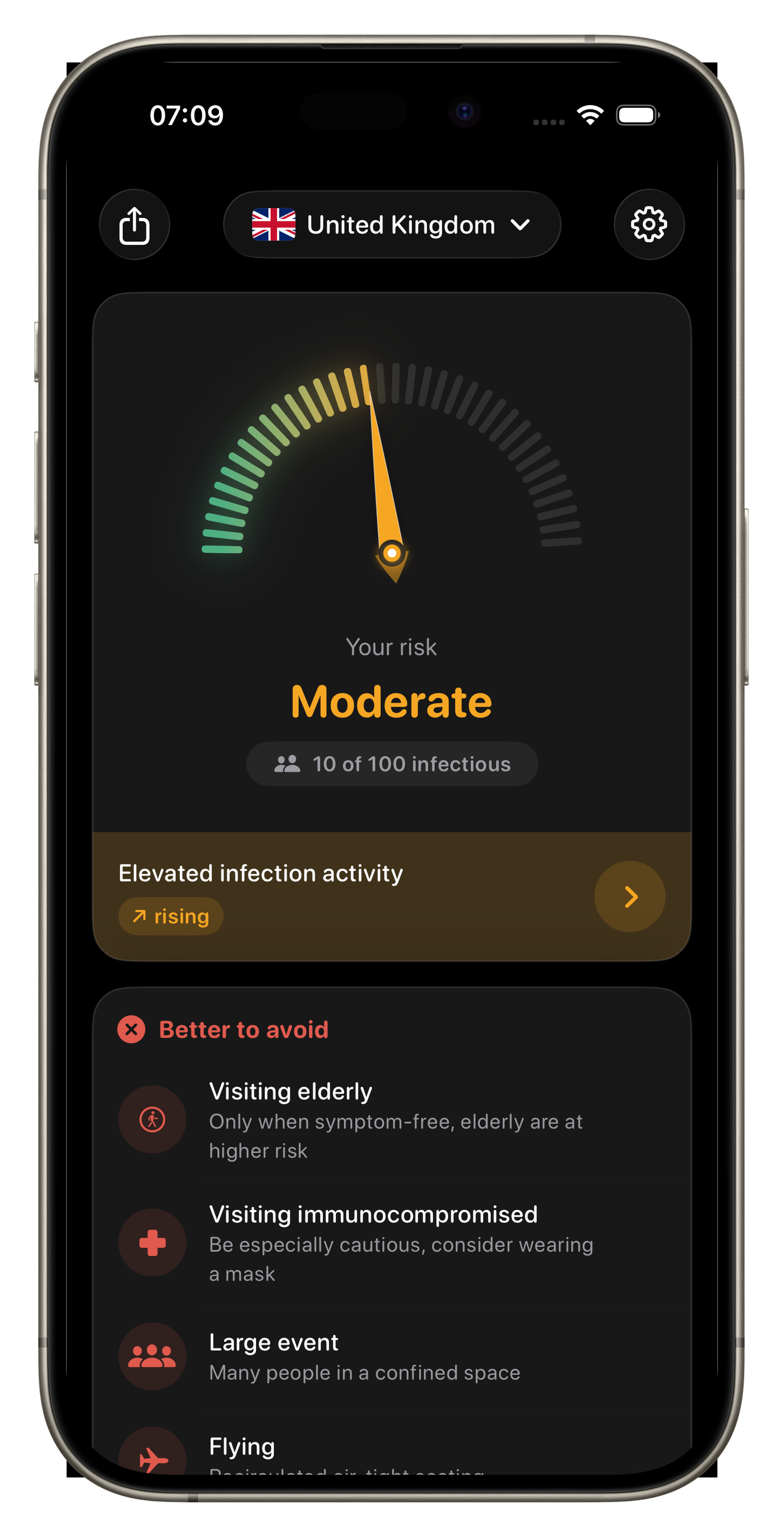
Here you only see the trend. In the app: exact incidence rates, “X out of 100 people infectious”, your personal risk based on age and pre-existing conditions, wastewater trends, 36 countries, home-screen widget.