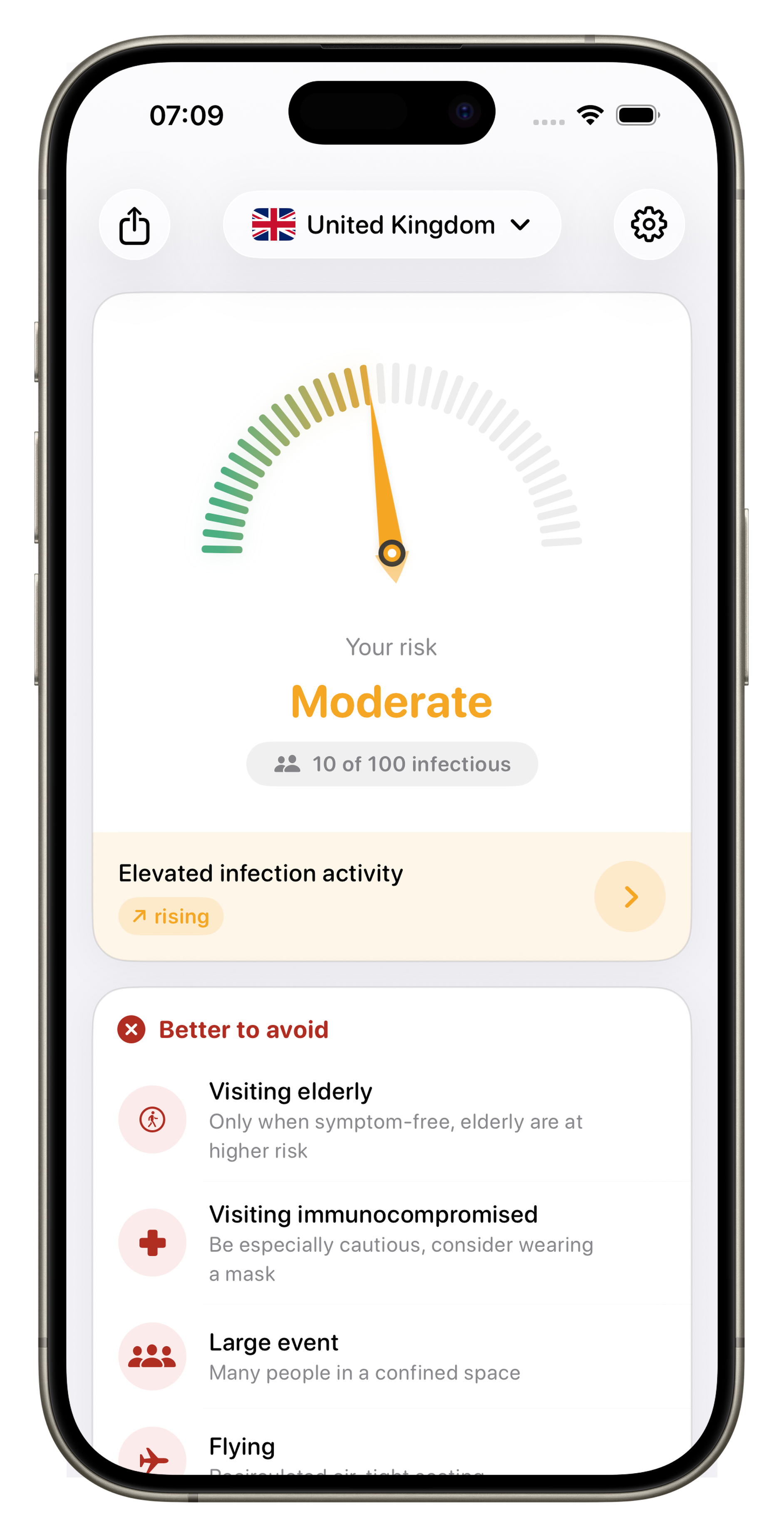
Respiratory illness in the United Kingdom
The three major respiratory pathogens side by side — influenza, COVID-19 and RSV — based on UKHSA Dashboard weekly data.
Current situation: Influenza
In week 15 of 2026, activity of influenza (seasonal flu) in the United Kingdom is low. The trend — derived from weekly hospital admission rates — is rising. Activity has barely shifted over the past few weeks.
The classification is based on the UKHSA Respiratory Surveillance Dashboard, combining hospital admission rates with the RCGP sentinel surveillance network run with the Royal College of General Practitioners. Seasonally, infection waves in the United Kingdom typically peak between December and February; activity is usually markedly lower during the summer months. How severe a given season becomes depends on the circulating virus variant and the population's immune status, among other factors.
Current situation: COVID-19
In week 15 of 2026, activity of COVID-19 in the United Kingdom is low. The trend — derived from weekly hospital admission rates — is falling. Over a four-week comparison, a clear decline is visible.
The classification is based on the UKHSA Respiratory Surveillance Dashboard, which aggregates COVID-19 hospital admission rates alongside RCGP sentinel indicators. Seasonally, infection waves in the United Kingdom typically peak during winter, with occasional summer waves driven by new variants; activity is usually markedly lower in late spring between waves. How severe a given season becomes depends on the circulating virus variant and the population's immune status, among other factors.
Current situation: RSV
In week 15 of 2026, activity of respiratory syncytial virus (RSV) in the United Kingdom is low. The trend — derived from weekly hospital admission rates — is stable. A slight downward trend has emerged over recent weeks.
The classification is based on the UKHSA Respiratory Surveillance Dashboard, which tracks RSV hospital admission rates together with RCGP sentinel surveillance indicators. Seasonally, infection waves in the United Kingdom typically peak between December and February; activity is usually markedly lower in spring and summer. How severe a given season becomes depends on the circulating virus variant and the population's immune status, among other factors.
Data sources and methodology
The current picture for the United Kingdom is built on the UK Health Security Agency (UKHSA) Dashboard. UKHSA is the national public-health authority for England and publishes weekly NHS England hospital admission rates for influenza and RSV, alongside daily case rate data for COVID-19. We rescale these signals into a consultation-equivalent indicator so the qualitative “low / moderate / high” categories are consistent with how we report other countries.
UKHSA Dashboard
The UKHSA Dashboard is the official public data portal of the UK Health Security Agency. It aggregates surveillance data from NHS England, sentinel primary care networks and laboratory reporting. For our headline level we use the weekly hospital admission rates for flu and RSV, and the daily COVID-19 case rate series.
Hospital admission rates
Flu and RSV are reported as laboratory-confirmed hospital admissions per 100,000 population per week, submitted by NHS England trusts. For COVID-19 the UKHSA Dashboard exposes a daily case rate series, which we aggregate into a weekly rolling mean. Together these give a stable signal of severe respiratory illness pressure that is robust to changes in individual testing behaviour.
Why this source
UKHSA is the authoritative source for England-wide respiratory surveillance and the only one to publish hospital admission rates with national coverage on a weekly cadence. Hospital admissions reflect the load on the healthcare system and update with roughly a one-week lag, while the COVID case-rate series tracks transmission more directly.
Qualitative classification
The “low”, “moderate” and “high” categories follow seasonal reference values and epidemiological thresholds calibrated to match our classifications for other countries. Admission rates and the COVID case-rate series are scaled to consultation-equivalent incidence using pathogen-specific conversion factors derived from typical seasonal peaks. Data refreshes weekly when UKHSA publishes the latest Dashboard update.
Frequently asked questions
How is overall respiratory-illness activity tracked in the UK?
UKHSA publishes a combined weekly surveillance report covering influenza, COVID-19, RSV, and other respiratory pathogens, alongside the UKHSA Dashboard. The picture is built from GP consultations via the RCGP sentinel network, hospital admissions and critical care data from SARI-Watch, and laboratory-confirmed cases. On infectrisk.com we summarise the combined picture qualitatively as low, moderate, or high rather than publishing raw case counts.
Did the UK experience a “tripledemic”?
“Tripledemic” is shorthand for the simultaneous winter circulation of flu, COVID-19, and RSV, a pattern first widely reported in the 2022–2023 season. The UK saw clear co-circulation of all three pathogens that winter, with significant pressure on NHS urgent and emergency care. Since then co-circulation has become the norm each winter, even if the relative intensity of each pathogen varies.
Why do respiratory illnesses peak in a UK winter?
Several drivers line up. Many respiratory viruses remain stable for longer in cold, dry indoor air, and heated buildings reduce humidity in ways that impair airway defence. People gather indoors more during winter, schools act as mixing points, and darker days change behaviour in ways that increase close contact. The net effect is that transmission rises just as immunity to seasonal strains is at its lowest.
What is “immune debt”?
“Immune debt” describes the idea that when pathogens circulate at very low levels for a prolonged period, as during the COVID-19 restrictions, population-level immunity to them gradually declines. Subsequent seasons can then be unusually severe because fewer people have recent immune exposure. It is a temporary catch-up effect rather than a permanent change, and it partly explains the heavy UK RSV and flu seasons that followed the pandemic.
How does UKHSA decide that activity is “high”?
UKHSA uses thresholds derived from historical surveillance data. Current GP consultation rates, hospitalisations, and positivity are compared against baselines from past non-epidemic weeks and against severe-season reference points. When several indicators cross into elevated ranges at the same time, the weekly report classifies activity as high or very high. These data-driven bands help separate ordinary seasonal movement from genuine surges.
Want the actual numbers?
You'll find them in the app.
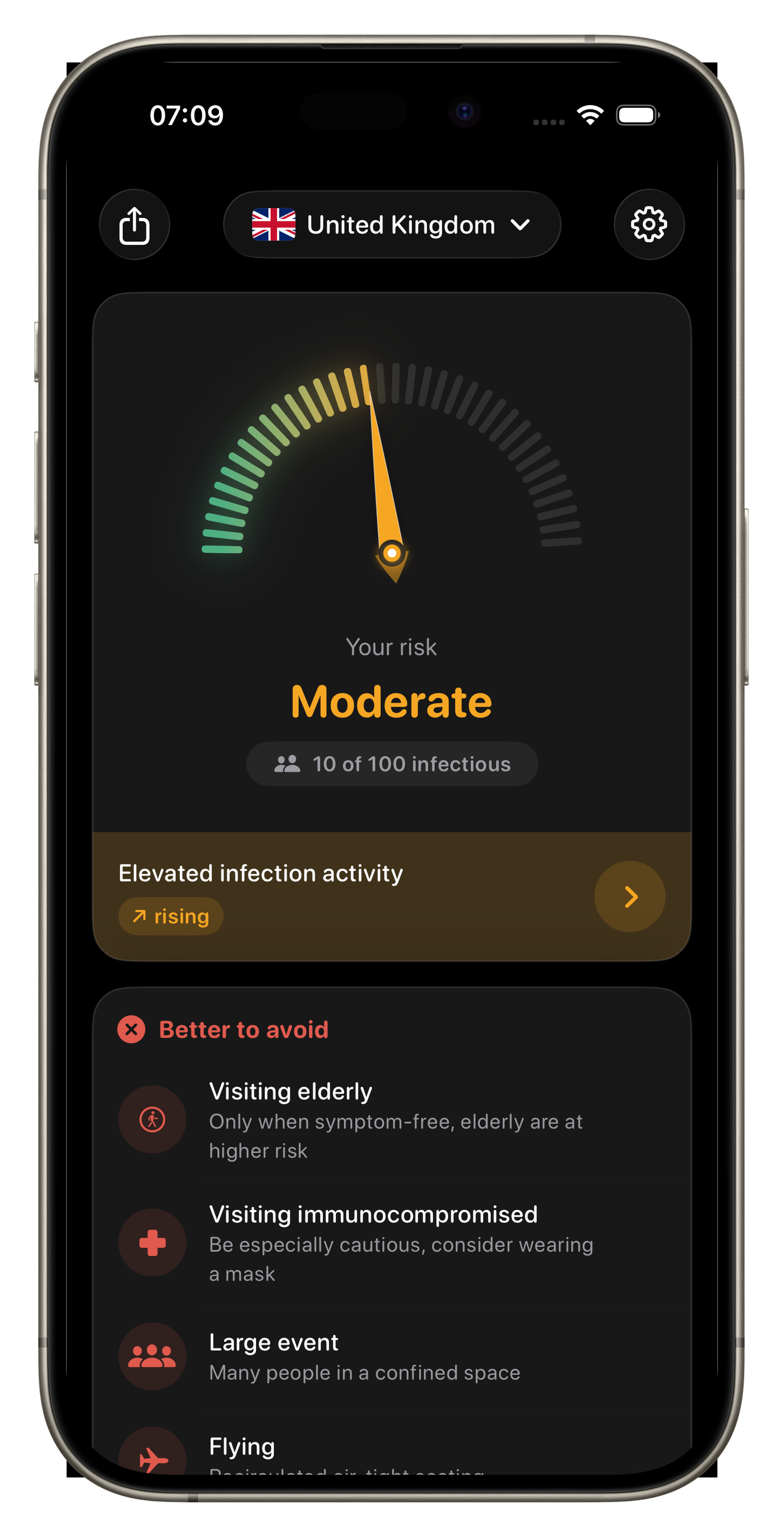
Here you only see the trend. In the app: exact incidence rates, “X out of 100 people infectious”, your personal risk based on age and pre-existing conditions, wastewater trends, 36 countries, home-screen widget.